
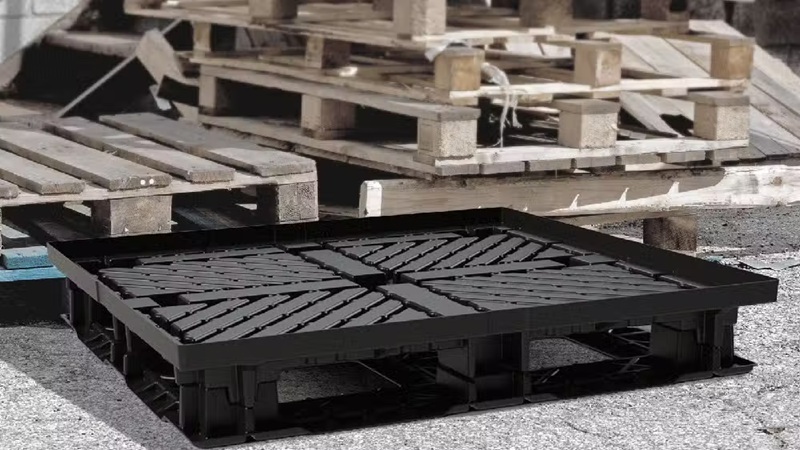
There is a moment in every serious policy debate when the evidence stops being theoretical and starts being undeniable, and the debate over plastic pallets versus wooden pallets reached that moment some years ago in the warehouses, cold storage facilities, and pharmaceutical distribution centres where the consequences of the wrong choice are measured not in abstractions but in contaminated shipments, failed audits, and operational disruptions that ripple outward through entire supply chains. The question is no longer whether plastic represents a genuine alternative to wood. It is what the comparison looks like when examined honestly and in full.
The answer requires looking at two specific dimensions where the comparison is most consequential: hygiene and durability. On both counts, the evidence assembled by industries that have made the comparison carefully points consistently in one direction.
The Hygiene Case
What Wood Actually Does
To understand why hygiene-sensitive industries have moved away from wooden pallets, it is necessary to understand what wood is at a material level. It is a biological substance, porous and fibrous, with a surface structure that absorbs moisture, retains organic material, and provides conditions in which bacteria establish and persist. Surface treatments and heat processing address some of these characteristics, but they do not eliminate them. A wooden pallet that has been in service for any length of time carries a microbial history that no visual inspection can fully account for.
Splinters and protruding fasteners compound the problem. They damage packaging, create entry points for contaminants, and present injury risks to warehouse personnel. In food and pharmaceutical operations, these are not minor inconveniences. They are audit findings.
What Plastic Offers Instead
Plastic pallets present a fundamentally different hygiene profile. Their surfaces are non-porous, smooth, and chemically inert. Bacteria do not penetrate the material. A plastic warehouse pallet can be pressure washed, sanitised with industrial cleaning agents, and returned to service in a condition that a wooden pallet, however thoroughly treated, cannot replicate.
In food processing environments, pharmaceutical manufacturing, and medical supply operations, this cleanability is a compliance requirement. Regulatory frameworks governing these industries place explicit requirements on the hygiene properties of materials that contact or support their products. Plastic pallets meet those requirements by design. Wooden pallets meet them, where they meet them at all, through workarounds that add cost and complexity without fully resolving the underlying material limitation.
The Durability Comparison
The Variability Problem in Wood
Durability in a wooden pallet is not a fixed quantity. It is a range, and the range is wide. Grain direction, knot density, moisture content, and conditions of use all affect how a wooden pallet performs and how long it lasts. This variability is not a defect that better manufacturing can eliminate. It is a property of the material itself.
The consequence is a pattern of failure that is difficult to predict and therefore difficult to manage. In automated warehouse environments where pallet failures disrupt conveyor systems and racking configurations, this unpredictability carries a cost that extends well beyond the replacement price of a single pallet.
The Consistency of Plastic
Heavy-duty plastic pallets are manufactured to consistent specifications from materials whose properties do not vary between units or change with environmental conditions. The load rating of a plastic pallet reflects what that pallet will reliably do. It does not absorb moisture and therefore does not swell, warp, or lose dimensional stability as humidity varies. Its dimensions remain consistent across temperature cycles, from cold storage to ambient distribution and back again.
Lifespan comparisons between the two materials tell a consistent story. A wooden pallet in demanding industrial use typically requires replacement within one to three years. Quality plastic pallets in the same application will routinely remain in service for ten years or more. Across the volume of pallets that a significant logistics operation uses, this extended lifespan transforms the higher upfront cost of plastic into a demonstrably lower total cost over time.
The Regulatory Dimension
Wooden pallets moving across international borders are subject to ISPM 15 phytosanitary regulations requiring heat treatment or fumigation to prevent the spread of invasive species. Plastic pallets carry no such requirement. They cross borders without the compliance processing, documentation burden, and logistical delay that ISPM 15 imposes on wooden alternatives.
For operations exporting from Singapore and across Southeast Asia, where regional trade volumes are substantial and supply chain efficiency is a competitive priority, this exemption is a meaningful reduction in friction at precisely the point in the supply chain where delays carry the greatest cost.
An Evidence-Based Conclusion
The comparison between wooden and plastic pallets is not a close one when examined on the dimensions that matter most to modern industrial operations. On hygiene, the non-porous, cleanable surface of a plastic pallet addresses contamination risks that wood cannot resolve by its nature. On durability, the consistency, dimensional stability, and extended lifespan of plastic outperform wood across every demanding application. On regulatory compliance, plastic eliminates requirements that wood cannot escape.
These are not arguments of preference or fashion. They are the conclusions that industries operating under genuine performance and compliance pressure have reached by working through the evidence, and the evidence leads, reliably and without equivocation, to plastic pallets.